‘St Andrews is an environment in which you can spread your wings’

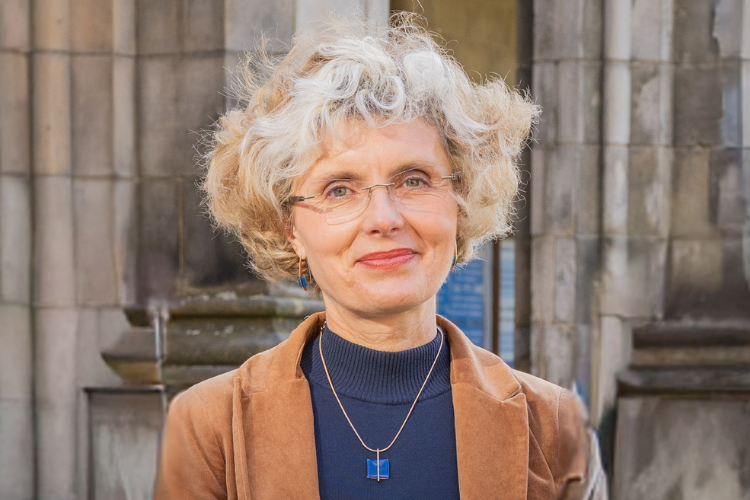
Accumulating and sharing knowledge, driving change and innovation – these are the purposes of universities, and it’s hard to think of someone who lives and breathes them more than Ester Ruskuc, the University of St Andrews Chief Operating Officer (COO) and Vice-Principal (Strategy).
Ester is the first woman to become COO at St Andrews – but this is by no means her first ‘first’ at the University.
Since 1993 she has held no fewer than nine positions, and most of these as the pioneering person in post. From Finance to Registry, Business Improvement to Planning, her career has spanned units and spawned functions.
Let’s start at the very beginning.
St Andrews is calling
Ester completed a degree in Mathematics and Computer Science at the University of Novi Sad, in the former Yugoslavia, and was teaching Computer Science and Mathematics at a secondary school in 1992 when her partner Nik (now a Professor in the School of Mathematics and Statistics) was accepted to study a PhD in St Andrews.
“I remember the phone call when Nik said: ‘well I’ve ensconced myself here and it’s not that bad, so you could come too’. I joined him and left that life behind.
“When you’re young, those are the moments to take such steps because you actually don’t know what you’re doing, and you don’t know what a big change it is going to be to your life. When you can better assess consequences and, depending on whether you are more or less risk averse, you might not do it. But, at that time, I just thought ‘here I come’ and that was that.
“It was a big change of course, the fact I had a degree and qualification didn’t necessarily mean a huge amount here at the time, as Britain wasn’t as open or as interactive with qualifications of the world.
“At that time the overseas student population at St Andrews was still below 10% and the overall student population was either just under or just over 5000, so we are talking about a university that was much, much smaller, looked a different way, and didn’t necessarily know how to interpret qualifications from other countries.
“That took me by surprise, so I realised I would have to show what I could do, rather than be given a certain benefit of the doubt.
“I also realised that the English I learned in school wasn’t the English I could just use for work or day-to-day life. Yes, you can get by, but it doesn’t mean that you really understand what people say when it comes to the contextual, societal meaning of things, the inferences.
“I needed to find ways to plug the social gaps, and language gaps, so I set about reading all the Jane Austen I could get, I watched some of the soaps to pick up what was going on and interacted with as many people as I could.
“Nik and I decided to set up shop and live together. His career also had to start, from being a PhD student, so the two of us had to think about who does what and earning a living.
The interview that started it all
“As soon as I was allowed by immigration, I took the first opportunity that came up – a Grade 2 Administrative Assistant role in Registry, in the Old Union building. After five months, I applied for the job of Cash Office Manager, and on the interview panel was the then University Secretary and Registrar David Corner, who recently passed away.
“I distinctly remember that interview because I really felt that the University decided to bet on me. I could tell that I made a lot of sense, but I could also tell that I wasn’t speaking the language of the interview, that I didn’t know how to have a good interview, and that what they were hearing was raw articulation, if you like, of potential and ambition.
“I will remain grateful for the interview that really got me into the University, and the broader opportunities of the institution.”
Most of us who have faced a few interviews in our careers will recall a time when someone saw something in us and chose to give us an opportunity which opened doors, and the gratitude that goes hand-in-hand with that.
It’s then up to us to make the most of the opportunity that’s presented and, to make sure that she did, Ester kept in mind some wise words of advice.
“One of the things my Mum always used to say as I was growing up was: ‘if you help yourself God will help you too.’ I think that has been a motto of how I approach things in life. I grab opportunities, I build on them, and I use the kinds of things that motivate me to open up avenues.”
Ester’s background in Maths and Computer Studies stood her in good stead at a time when computing advances were empowering technological innovation like never before, and she was able to capitalise on the moment.
“I had ambitions to make computers work for people and that has never left me. I always knew what they could do, I spoke the language of talking about them, understanding them, putting them in place, making use of them in a way that wasn’t frightened, that didn’t feel threatened by them, but was also challenging and questioning of them.”
Putting cultural difference to work
Ester was also able to put to good use the cultural differences between her homeland and the UK.
“Where I come from there isn’t a concept of ‘elephant in the room’ so I would go into a meeting, and I would call things out and that would unsettle the situation. It wouldn’t always necessarily be a bad thing, but it would mean that people knew that if I was present things could happen that they wouldn’t expect.”
If you have been in a meeting with Ester, you are most likely now nodding in recognition, and if you haven’t, it’s likely that you’ve heard others talk about this undeniable aspect of her character. In a sector where word counts often override brevity and an old-fashioned favour for polite indirectness lingers, her straight talking is as refreshing as it is impressive.
“I have grown to understand that some gaps will never close but that’s okay. In some sense, the fact I can cross-operate across two societies or communities of people, yes it means I’m a bit of an outsider in both, but also the way I can see across both, and the way I can interpret across both puts me in quite a different, and not necessarily disadvantaged, position.
“It takes time before one can realise this and be able to function and be comfortable with it. I now think of it as a super asset. But it takes time to make it into an asset.”
With this superpower developing, Ester began to look more widely at the systems and processes that needed modernising in the University, something that would become the hallmark of her career.
“I worked in the Cash Office for a while, which was fun. It had its own complexities, it was very traditional, still had a coin counter and people came in with wodges of cash, so we introduced some automation and computers.”
And then came the happy but nevertheless career-disrupting decision to start a family. Even as recently as the 1990s, employment law and employers’ attitudes to women in the workplace were not what they are now.
“When it came to having my first child and going on maternity leave, it was a very different world. My boss said: ‘you cannot come back part time, there’s no flexible working, this job cannot be done part time’, but the financial controller at the time had a more positive and progressive outlook and said: ‘we will keep you in finance, if you’re willing to do something different, we will let you work flexibly’.
“I moved into financial accounts, then I had another maternity leave, and then I was part of the implementation of Aptos, which has just been phased out. In 2000 I became the first Helpdesk manager for IT Services, setting up the Helpdesk as an operation.
“That, for me, was the first job that I felt utilised my skills, my degree, I felt I’d arrived.
Opportunity knocks
“I immensely enjoyed all the opportunities that presented. I then worked on a number of projects – I implemented the the Online-Advising system, then the first online payment system. It was always improvement-oriented, making a difference to the broader University.
“Then I was asked to work with Registry who needed to leave the Old Union Diner because the floor was going to collapse under the weight of the paper. We needed to automate the operations. That’s when I came out of the IT environment and started working elsewhere in the University.
“Over time I became Director of Registry, then I saw opportunities to use the wealth of data across the institution to start informing some of the decisions, and what I wanted to do was set up a planning function. I wasn’t quite clear how to go about that, and I thought maybe I’ll apply for a job elsewhere to do that, but then the University said: ‘why don’t you stay and do it here?’ And so I became Academic Registrar.
“At the time this incorporated student records, matriculation, study abroad, partnerships, tuition fees, scholarships, results reporting, graduation support, the student numbers plan for finances – and that started broadening my horizons more significantly across the University.
“What I could do and the sphere of my opportunity to influence increased; as a result my wish to impact and improve also increased. That is what drove my career path, rather than any particular job title or specific job, and when you trace back all I’ve done, this would be a common theme rather than one particular goal.
“With Sally’s arrival, she saw that I had potential to work in strategy, which I didn’t know, and when I started working on strategy-related matters for the University, I felt at home. Someone saw something in me that I didn’t even know existed, and I immensely enjoyed that.”
With her strengths in strategy, systems and finance, promotion to COO seemed a natural progression, and now that she is in post, Ester is keen to join up all the dots she has made during her 33-year career at St Andrews.
Joined-up thinking
“One of the ambitions I’ve got in this role is connecting operations and strategy more closely and in a way that is more seamless.
“Getting strategy to live even more in what we do day to day is an ambition for me.
“I want to mobilise as well as enable the service directors. We have incredible people leading our services, and I’m excited about what potential we can unlock when forces join even more intentionally. As we move towards service-based planning and conversations, we can collectively understand what we’re valuing and prioritising: the quality we aim for, the costs we manage, and how we collaborate to deliver. This approach helps us bridge the gap between strategy and operations, aligning our day-to-day work with the bigger picture and enabling more joined-up thinking across services.”
With Professor Dame Sally Mapstone at the helm and eight women in the senior management team of the Principal’s Office team of 14, there are more women in positions of power at the University than ever before.
As the saying goes, ‘you can’t be what you can’t see’ and that is why it is so important to have visible role models to encourage women who are starting out in their careers to pursue their ambitions.
And, although the University exists primarily for learning and teaching, the majority of permanent staff members work in professional services rather than academia – 1,924 to 1,357 – so having a Chief Operating Officer who is not an academic provides an important representation of an alternative path to senior management.
When this is pointed out to Ester, she is surprised, but pleased, because inspiring and empowering others is something that is important to her.
“The other thing that I’ve decided to do is – not a new decision, I’ve been acting on for a while now – is nurturing others. If I see that people have potential and ambition then I am willing to have conservations or listen or give ideas to help them along and I’ve done that quite consistently, in particular with women.
“I can never give back exactly the same, but even if I make a difference to people in the way that I felt embraced and given opportunity here then I think I would feel quite pleased about that.”
Over a career that already spans four decades, Ester has seen, and been part of, many changes in the University and the Higher Education sector.
“Either change found me, or I found change, but that has been important to me, because that links to self-improvement, self-development and the opportunity to make a positive impact.
“Two things that have always motivated me, and still motivate me, are the ability to learn and improve myself; and to make a tangible difference.”
Her advice to anyone who feels the same is clear: “I always say to people that St Andrews is an environment in which you can spread your wings. If you are chasing the title or the money there will be limitations on that, because the University can have only so many vice-principals or so many directors, but the University doesn’t restrict how many people can learn something, or how many people can try something, or who the people are that can make a difference on a particular project.
“So, if you have something to contribute, go for it, you never know where it will take you.
“If people in charge know, they tend to create those opportunities and spaces for us to grow and act and I think that’s wonderful.”
Ester is not one for looking back, preferring to focus on the next challenge and the next project, but it would be remiss not to ask what she would say to her younger self if she had the chance, and the answer, which comes without a moment’s hesitation, is one that will resonate with many women.
“’Don’t be so hard on yourself’ – I’ve always worked very hard and when some things didn’t go in the way I wanted them to go I always found fault only in me.
“I think trying to understand the bigger picture of what happened in a particular situation from which we learn is really important, because it’s not only about the mistakes we make – the learning can be broader than just about correcting something we have done.
“I think talking to others, getting a little bit of feedback, having sounding boards is really important. It doesn’t make you smaller, it makes you bigger, it makes you stronger, and it makes you more confident.
“Don’t clip your own wings. The world has clippers it wields anyway.’
What’s next?
Looking to the future, Ester has much she wants to accomplish and won’t be stopping anytime soon.
“I am very aware that it is very much a changing time for Higher Education. There are issues around funding and issues around perception.
“We know that people who engage with Higher Education tend to experience better life outcomes, including improved health, greater economic contribution, and stronger support for the next generation. These benefits are well-evidenced and far-reaching. Yet, as the landscape evolves, it’s clear that we need to adapt. That means being open to change so we can continue to demonstrate the value of Higher Education, our distinctive contribution to it and ensure it remains a strong investment for individuals and society alike.
“I have an ambition to be part of that reshaping in a positive way, together with the wonderful colleagues and students we have in St Andrews. When I leave, I want to know that the foundations are stronger for my contribution for the next stage of where the University goes.
“St Andrews has been here for 600 years, I believe it will be here for another 600 years.”
Discover more from Staff news
Subscribe to get the latest posts sent to your email.