Shining a light on eclipse expeditions

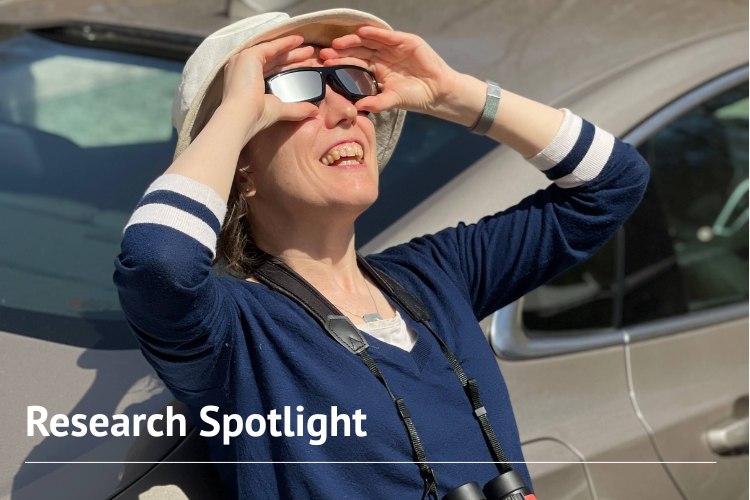 This week, Research Spotlight is being ‘eclipsed’ by the history of mathematics as Dr Deborah Kent shines a light on her work.
What’s your name and what do you research?
My name is Deborah Kent. My research focuses on mathematical sciences in the 19th and early 20th centuries. I love archival work! Reading letters, diaries, manuscripts, notes, and rare books, can give rich insight on people and mathematical activities in other times and places. Lately, I’ve studied eclipse expeditions — especially 1860, 1869, 1898, and 1941 — in which mathematical practitioners have great globe-trotting adventures in hopes of using new technology to answer major scientific questions.
Why is it important to look at the history of mathematics?
The history of mathematics connects us with mathematical practitioners around the globe and throughout time. Studying the history of mathematics can increase cultural literacy and sensitivity, in addition to helping to shape self-understanding of the present and hopes for the future. We often find in history close parallels to current challenges that can inform contemporary concerns.
The history of mathematics also provides context and illuminates the nature of knowledge emerging amid false starts, wrong turns, and human struggles in specific educational, institutional, and social contexts. This is fascinating in its own right, and can also help current practitioners appreciate the arc of mathematical endeavour and to understand the origins of modern problems. Beyond that, the history of mathematics is intimately connected to the development of institutions, educational structures, economic factors, cultural values, individual biographies, and geopolitical concerns. Beyond deepening knowledge of mathematical practice, studying the history of mathematics also connects us with human endeavours more broadly.
How have people interpreted eclipses through time?
A total solar eclipse is awe-inspiring and rare, with the day literally turning into night — a notable astronomical event in many civilizations. We have thousands of years of documented eclipse observations, from petroglyphs in Ireland believed to be recording an eclipse on 30 November 3340 BCE to stunning digital images made with high dynamic range techniques during eclipse totality on 8 April 2024.
Chinese oracle bones with eclipse records from around 1200 BCE carry messages of the sun being eaten (these records helped twentieth-century NASA astronomers calculate the Earth’s rate of spin). The Maya astronomical record — in hieroglyphs, murals, and codices — includes meticulous tables for predicting eclipses, viewed as signs of ominous heavenly clashes. Evidence shows that Australian Aboriginal people also understood the Sun-Earth-Moon system and knew an object covered the Sun during a solar eclipse, which many viewed as an omen of impending calamity. An ancient Indian interpretation attributes a solar eclipse to the demon Rahu consuming the Sun and Moon, making days near an eclipse a terrible time to begin anything important. To the contrary, some schools of tantric yogis believe that eclipses helpfully intensify spiritual practices and expedite personal transformation.
The many Indigenous groups in North America have various interpretations of solar eclipses, such as a Cherokee narrative of a frog who swallowed the Sun and the Kwanlin Dün belief that someone who saw an eclipse would turn into stone. Broadly speaking Indigenous North American approaches to a solar eclipse are characterized by reverence for the alignment, perhaps expressed with singing or chanting, and spending time inside with loved ones.
With the total solar eclipse on 29 May 1919, came an interpretation of eclipse observations that validated Einstein’s theory of general relativity — the idea that gravity of a large object like the Sun could warp spacetime, bending light to make stars appear in the wrong place in photographs taken during the eclipse.
Why do you think they are such an important phenomenon to study?
Solar eclipses have been a source of human fascination since early times. From the recognition of eclipse recurrences to highly sophisticated mathematical modelling, eclipses have inspired thinkers to advance forms of mathematical inquiry in both direct and nuanced ways .In ancient and pre-modern periods, various mathematically active societies generated key insights that were both culturally specific and diachronic. Nineteenth-century technologies of photography and spectroscopy raised new questions about research methodology and criteria for accepting or validating a mathematical result. Study of the solar corona continues to be at the cutting edge of mathematical science. This cultural and intellectual activity has a broadly global aspect and the heritage of all of humanity is connected to the history of eclipse observation.
A total solar eclipse is a fully immersive shared experience — the light dims, the temperature drops, a breeze rustles, wildlife reacts, planets appear — merging a moment of distant celestial alignment with vincinal immediacy. The corona itself is a transcendent marvel, a fleeting phenomenon that elicits a shared sense of awe and wonder. People in many places at different times have responded to total solar eclipses with various questions and interpretations. Eclipse observation is a human experience with connective power across time and space.
Tell us about your own experience
I’ve been very fortunate to experience clear skies for two Total Solar Eclipses: 21 August 2017, at a city park in Nebraska; and 8 April 2024, at a green space in Indiana. I’ve booked my trip for August 2026 and have high hopes for a third experience of totality. My first view of the corona was overwhelming — too much to take in, in what felt like an instant. I gained some sympathy for 19th-century observers who officially reported that they were so overcome by the corona that they forgot to collect data! After experiencing totality myself, I better understood why even the driest of technical expedition reports bursts into a few paragraphs of rhapsodic awe to describe the corona.
What are you working on next?
In December 2025, I’m running an ICMS workshop at the Pacific Institute of Mathematical Sciences titled “Big Data before “Data Science”: legacies from the collection, analysis, and communication of large-scale human data from an era of paper tools”
This workshop will bring together statisticians, data scientists, and historians to examine the persistent traces of past data practices and their implications for the present and future of the field.
Data science today is inextricably bound to digital technologies of analysis. Similarly, the paper tools that originated in the 19th century informed the collection, analysis, and communication of data. Even as the paper tools have been replaced by modern machines, many of the associated practices remain. Against the ever-increasing pace of novel standards in speed, efficiency, and computational power, it is imperative carefully and critically to examine the persistent traces of historical precedents and benchmarks in processes of data collection and analysis. In light of the continuing impact of the history of statistics and data science on its current practices, participants will consider how historical insight informs contemporary practices and principles.
If you would like to feature in Research Spotlight, have had a paper accepted or would like to discuss how to amplify your work in the wider media, please contact Senior Communications Manager Ruth Sanderson rjs21st-andrews.ac.uk
Discover more from Staff news
Subscribe to get the latest posts sent to your email.