A lifetime of impact on public health and the people behind it

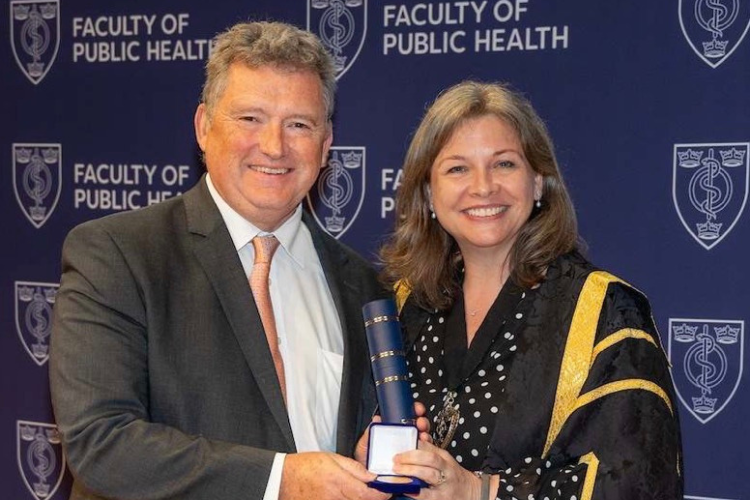
For more than three decades, Professor Peter Donnelly has worked at the intersection of medicine, public health, research and policy, helping shape approaches to some of society’s most pressing health challenges while mentoring and supporting countless colleagues and students along the way.
Today, as Professor of Public Health Medicine at the University of St Andrews, Peter’s work spans research, teaching and supervision, with current interests ranging from health inequalities and dementia to addiction, gambling and diagnostics.
His career has also taken him into some of the most senior public health roles in the UK and internationally, including serving as Scotland’s Deputy Chief Medical Officer and leading one of Canada’s largest public health organisations.
Recently recognised with the Alwyn Smith Medal, the highest honour awarded by the UK Faculty of Public Health, we sat down with Peter to discuss public health, leadership, mentoring and why understanding people matters more than ever.
Like many people working in public health, Peter did not set out with a clear career plan.
“At school I was interested in politics, current affairs and how society worked. Because I did well academically, the advice was essentially to study medicine or law. Law didn’t particularly appeal to me, so I ended up studying medicine.”
While medicine provided a foundation, Peter soon realised he was most interested in the wider factors that influence health and wellbeing.
“I think if we’re lucky, we gradually migrate back towards our intellectual hinterland. The things I’ve ended up doing are much more connected to government, policy and society than to the traditional conception of being a doctor.”
That intersection of research, policy and real-world impact has been a consistent thread throughout his career.
“The thing I enjoy most is where research and policy come together. Where research allows you to make a difference or allows you to show that you have made a difference by changing policy.”
Making a difference beyond the data
That philosophy can be seen throughout his work, whether examining violence as a public health issue, contributing to major public health reforms in Scotland, or helping shape healthcare policy internationally.
Yet despite receiving one of the highest honours in public health, Peter is reluctant to focus on personal achievements, instead recalling the individuals whose lives changed after receiving guidance, encouragement or support at the right moment.
One story centres on a young refugee in Canada who was struggling to secure employment.
“She recognised me from a lecture I had given and told me she’d completed a Masters in Public Health but couldn’t get a job in the profession.
“She’d come as a refugee from a war-torn country and experienced health inequalities first hand. To me, her life story was compelling, but none of it was in her application.”
After helping her reframe her CV, she secured a role in one of Canada’s largest public health departments.
“The whole thing took less than an hour of my time. But that hour changed the course of her career.”
He shares several similar stories, including mentoring a former research assistant into medicine and supporting a young man with an idea for a socially focused transport company who went on to build a successful business.
“What they often needed was someone to listen to them and say: ‘That sounds like a good idea. What’s the next step?’ People sometimes need someone to listen and help them recognise their own value.”
Why mentoring matters
As his career has progressed, Peter has become increasingly passionate about developing others. He has supervised students, supported early career researchers and helped train future public health professionals across multiple countries.
“I can remember one individual who made an enormous difference to my own career. Whenever somebody asks me for help, I think about that person and I think, ‘Of course I’m going to help. Somebody did that for me.’
He believes universities have a particularly important role to play in nurturing talent.
“During your formative years, a few words from the right person can make a huge difference. Equally, the wrong words can stay with you for years. That’s made me very thoughtful about always trying to be on the right side of that balance.”
That commitment continues through his teaching and supervision at St Andrews.
“Working with students and seeing them develop confidence and expertise remains one of the most rewarding parts of my job.”
Peter’s views on leadership have been shaped by experiences across academia, government and healthcare. For him, leadership is less about authority and more about creating the conditions in which others can thrive.
“The most important thing a leader can do is develop the people around them. Leadership isn’t about having all the answers. It’s about helping other people succeed.”
Understanding people
Much of Peter’s research has explored issues that are often complex and deeply rooted in people’s lives, including inequalities, addiction, violence and disadvantage. He believes that effective public health starts with understanding people’s experiences.
“We’re often very good at telling people what they should do. We’re sometimes less good at understanding why people do what they do. If we genuinely want to improve people’s health and wellbeing, we need to understand the realities of their lives. Statistics matter, but so do stories.”
That perspective has shaped much of his research and policy work, whether addressing violence, health inequalities, substance use or diagnostics.
This human-centred perspective has informed his work throughout his career and continues to shape his current research interests. Today, Peter continues to balance a range of roles beyond the University.
Alongside teaching and supervising students, he leads or contributes to a broad portfolio of research projects and serves on numerous committees and advisory groups.
Beyond the University, he holds an honorary consultant contract with NHS Fife and serves as a non-executive director of the Milbank Memorial Fund in New York, where he chairs its governance committee.
The organisation works across political divides to promote evidence-based health policy in the United States, something Peter sees as increasingly important.
“So much of what happens in the United States eventually influences healthcare policy elsewhere. Helping improve the quality of evidence-based decision making at source feels like a worthwhile use of time.”
His career has influenced legislation, health systems and public policy across multiple countries, yet when asked what he’d like his legacy to be, Peter’s answer comes immediately.
“Helping others.”
He smiles.
“Seeing somebody else succeed, knowing you’ve played a small part in that journey, that’s incredibly rewarding.”
It’s an ethos reflected throughout his career and neatly captured by a phrase he has carried with him for many years, borrowed from the fictional detective Harry Bosch: “Every body counts, or nobody counts.”
Discover more from Staff news
Subscribe to get the latest posts sent to your email.